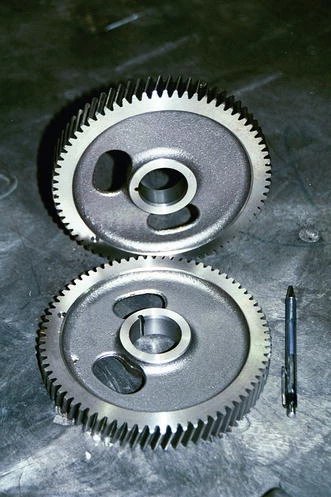
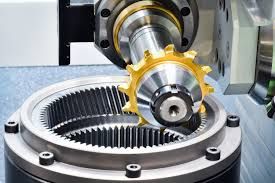
Here's a comprehensive comparison of case-hardened steel (ASTM A148 Grade 105/85 with surface hardness of 500 BHN), standard steel (ASTM A148 Grade 105/85), and ADI (Austempered Ductile Iron) Grade 1 (900-9) across key performance metrics for gear applications, including strength, wear resistance, fatigue resistance, noise damping, and environmental sustainability.
1. Material Overview
Case-Hardened Steel (ASTM A148 Grade 105/85 with 500 BHN Surface)
- Core Strength: Tensile strength of ~725 MPa, yield strength of ~585 MPa.
- Surface Hardness: Hardened to 500 BHN, significantly improving wear resistance.
- Applications: Suitable for high-wear, high-impact applications where surface durability and core toughness are critical.
Standard Steel (ASTM A148 Grade 105/85)
- Core Strength: Tensile strength of ~725 MPa, yield strength of ~585 MPa.
- Surface Hardness: Typically around 200-250 BHN without case hardening.
- Applications: Used in general engineering applications where toughness and strength are important but high surface wear resistance is not a primary concern.
ADI Grade 1 (900-9)
- Core Strength: Tensile strength of ~900 MPa, yield strength of ~600 MPa.
- Surface Hardness: Around 300-350 BHN, offering inherent wear resistance.
- Applications: High-strength gear applications with enhanced damping properties, ideal for high-load, high-cycle fatigue environments.
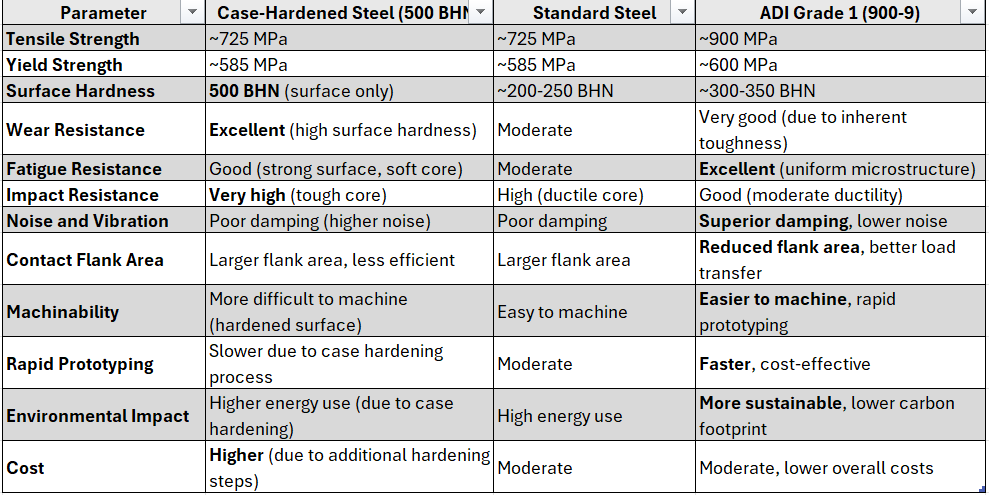
2. Key Performance Comparisons
3. Detailed Comparisons
1. Surface Hardness and Wear Resistance
- Case-Hardened Steel (500 BHN): The case-hardened surface offers superior wear resistance compared to standard steel and ADI. This makes it ideal for gears that are subjected to high-contact pressures and abrasive conditions.
- Standard Steel (200-250 BHN): Offers lower wear resistance without surface treatment, and is prone to wear under high-contact pressures.
- ADI Grade 1 (300-350 BHN): ADI offers inherent wear resistance due to its ausferritic matrix, which is tough and wear-resistant, though slightly lower than case-hardened steel.
Verdict: Case-hardened steel leads in wear resistance, followed by ADI, with standard steel being the least wear-resistant.
2. Fatigue Resistance
- Case-Hardened Steel (500 BHN): The hardened surface improves resistance to surface fatigue, but the softer core may still limit performance under high-cycle fatigue conditions.
- Standard Steel: Offers moderate fatigue resistance, but without the surface hardness, it may wear faster under cyclic loading.
- ADI Grade 1 (900-9): ADI has excellent fatigue resistance, thanks to its uniform microstructure, which makes it highly durable in high-stress, cyclic conditions.
Verdict: ADI Grade 1 excels in fatigue resistance, making it ideal for high-cycle gear applications.
3. Impact Resistance
- Case-Hardened Steel (500 BHN): The tough core provides very high impact resistance, making it ideal for applications where both surface wear and impact loads are present.
- Standard Steel: Offers high impact resistance, though without the surface hardness, it may wear faster.
- ADI Grade 1 (900-9): Provides good impact resistance, though not as high as case-hardened steel, particularly in extreme impact conditions.
Verdict: Case-hardened steel has the best impact resistance, while ADI offers good resistance with some compromise in extreme cases.
4. Noise and Vibration Damping
- Case-Hardened Steel (500 BHN): Steel gears, even with case hardening, are known for poor damping properties, leading to higher noise levels in operation.
- Standard Steel: Like case-hardened steel, it suffers from poor damping, contributing to noisy gear operations.
- ADI Grade 1 (900-9): ADI is known for its excellent damping properties, making it the best choice for applications where quiet operation is critical.
Verdict: ADI Grade 1 is superior in noise reduction and vibration damping.
5. Contact Flank Area and Load Distribution
- Case-Hardened Steel (500 BHN): The larger contact area of steel gears leads to less efficient load transfer, but the hardened surface helps in minimizing wear.
- Standard Steel: Has a larger contact flank area, leading to less efficient load transfer and faster wear in high-load situations.
- ADI Grade 1 (900-9): The reduced contact flank area in ADI gears results in better load distribution, improving gear life and performance under heavy loads.
Verdict: ADI Grade 1 offers better load distribution and longer gear life.
6. Machinability and Prototyping
- Case-Hardened Steel (500 BHN): After hardening, the material becomes more difficult to machine, increasing costs and time for prototyping.
- Standard Steel: Easier to machine than case-hardened steel but still requires more energy than ADI.
- ADI Grade 1 (900-9): ADI is easier to machine and cast to near-net shapes, making it ideal for rapid prototyping.
Verdict: ADI Grade 1 wins in machinability and rapid prototyping.
7. Environmental Impact
- Case-Hardened Steel (500 BHN): The case-hardening process requires additional energy, increasing the environmental footprint.
- Standard Steel: Steel casting consumes a high amount of energy, and its environmental impact is larger compared to ADI.
- ADI Grade 1 (900-9): ADI is more environmentally friendly, with lower energy consumption during production and a smaller carbon footprint.
Verdict: ADI Grade 1 is more sustainable from an environmental standpoint.
4. Conclusion: When to Choose Each Material
- Case-Hardened Steel (500 BHN): Best suited for extremely high-wear and high-impact applications where surface hardness is critical, but can be noisy and harder to prototype.
- Standard Steel (ASTM A148 105/85): A good general-purpose material for moderate-strength applications where impact resistance and machinability are more important than wear resistance or noise reduction.
- ADI Grade 1 (900-9): Ideal for high-fatigue and high-load applications requiring better damping, longer life, and cost-effective prototyping. It is also more environmentally sustainable.
In summary, case-hardened steel is best for extreme wear, ADI Grade 1 is ideal for fatigue resistance and quiet operation, and standard steel offers a balanced but less specialized performance.